
Your Guide to Finding & Mastering Wild Trees
You’re walking through a creek bed in the Santa Cruz Mountains on a quiet Saturday morning. The light filters through the canopy, and suddenly you spot it, a perfectly formed juniper, no more than 8 inches tall, growing between two rocks. Your heart races. This isn’t just a small tree you’ve stumbled upon. This is the beginning of a decades-long relationship. This is your first treasure in what could become a lifetime pursuit of bonsai mastery.
Finding wild bonsai isn’t about luck or weekend hiking. It’s about becoming an adventurer who understands forests, respects wild spaces, and knows exactly what to look for when you’re out there. This guide will take you from curious explorer to ethical bonsai hunter, someone who doesn’t just collect trees, but becomes their steward for life.
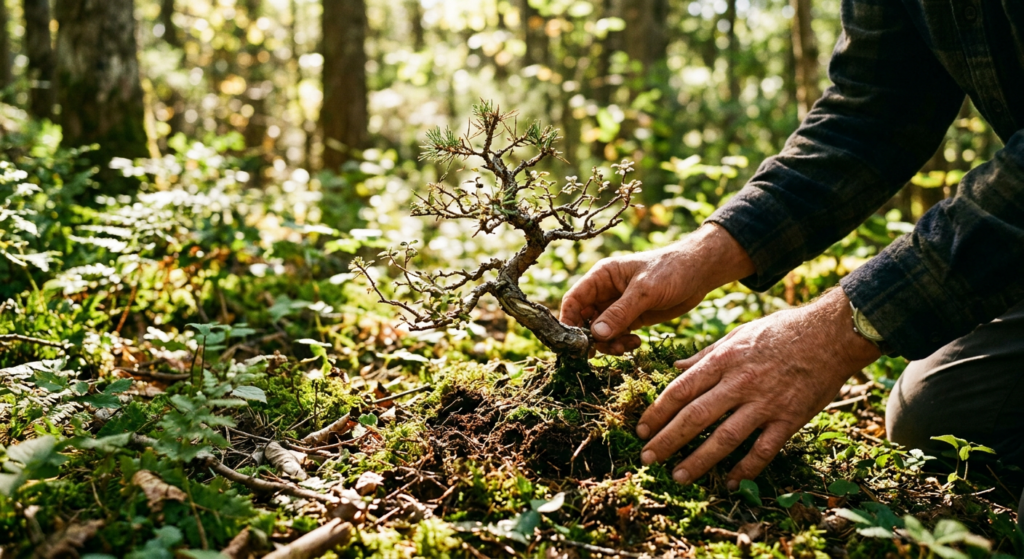
Why Hunt for Wild Bonsai? The Call to Adventure
There’s something different about a tree you’ve found yourself. Nursery bonsai are beautiful, but wild-collected specimens come with a story written in their wood. That gnarled trunk, that asymmetrical branch structure, those aren’t design flaws. They’re evidence of years spent in harsh conditions, wind stress, competition, survival. When you find a wild tree with natural bonsai character, you’re looking at a head start that would take 10+ years to develop from seed or cutting in a nursery.
For someone serious about becoming a bonsai master, wild collection offers something irreplaceable: authentic material with genuine age and character. You’re not starting from scratch. You’re inheriting a story.
But here’s the reality check: this isn’t a casual stroll through the park with pruning shears. It’s a commitment that demands patience, knowledge, and respect.
The Honest Truth: Pros & Cons of Wild Bonsai Hunting
The Pros
Mature character, fast: Wild trees have already spent years developing thick trunks, weathered bark, and natural form. Years of work are already built in.
Deeper connection: You know exactly where your tree came from. You can return to that spot. You understand its native climate, soil, and growing conditions, crucial knowledge for long-term care.
Cost-effective: Wild collection is free (beyond travel and tools). High-quality pre-developed bonsai nurseries can cost hundreds or thousands.
The adventure itself: Let’s be honest, there’s real romance in the hunt. It’s how you’ll remember the start of your bonsai journey.
Natural variation: No two wild trees are identical. Your collection will have unique specimens that you won’t find anywhere else.
The Cons
Shock and transplant stress: Uprooting a wild tree is traumatic. Survival rates are lower than nursery stock. You might lose your prize, especially in the first year.
Long acclimation period: Even if it survives, expect 6-12 months of weak growth while the tree recovers. You won’t be styling aggressively during this time.
Legal and ethical minefields: Collecting on protected land, in preserves, or in regulated areas can result in fines. Some species are protected. You need to know the rules before you hunt.
Time and physical demands: This isn’t a quick outing. Real bonsai hunting involves multiple trips, scouting, equipment, and physical exertion in variable weather.
Unpredictable results: Not every wild tree makes a good bonsai, even if it has character. You might harvest something that just won’t respond to development the way you hoped.
Ecological impact: Careless collection damages habitats and wildlife. This burden falls on you. Done wrong, you’re part of the problem.
The bottom line: Wild collection is rewarding, but it demands honesty about the time, risk, and responsibility involved. If you’re genuinely called to master bonsai, these challenges are worth it. If you just want a cool-looking tree quickly, buy from a nursery.
Scout Like a Pro: Planning Your Bonsai Expedition
Before you set foot in the wilderness, you need a plan. This is where most amateur collectors fail.
Identify Your Hunting Grounds
The best bonsai candidates grow in harsh conditions, places where trees have to fight to survive. Look for:
- Rocky outcrops and ridges: Exposed terrain that stresses trees into compact growth
- Streambanks and creek beds: Trees growing between rocks with limited soil space
- Forest edges and clearings: Where light competition creates dense branching
- Cliff faces and steep slopes: Gravity and wind create naturally asymmetrical forms
- Disturbed areas: Old burns, landslides, areas recovering from erosion, trees here are often gnarled and character-filled
In California (your home turf), the best hunting is in oak woodlands, chaparral transitions, and mixed conifer zones. Juniper, oak, manzanita, and pine species are your sweet spots.
Scout First, Harvest Second
Never hunt blind. Before you go tool-in-hand, scout the area on at least one preliminary hike. Map out:
- Where the best candidates are growing
- What species dominate the area
- Seasonal patterns (is this a seasonal creek bed? Will it flood?)
- Access difficulty and weather exposure
- Where you’re allowed to be
Use a phone’s map app or a basic GPS unit to mark promising spots. Take photos. Note the date. Return when conditions are better or you’re better prepared.
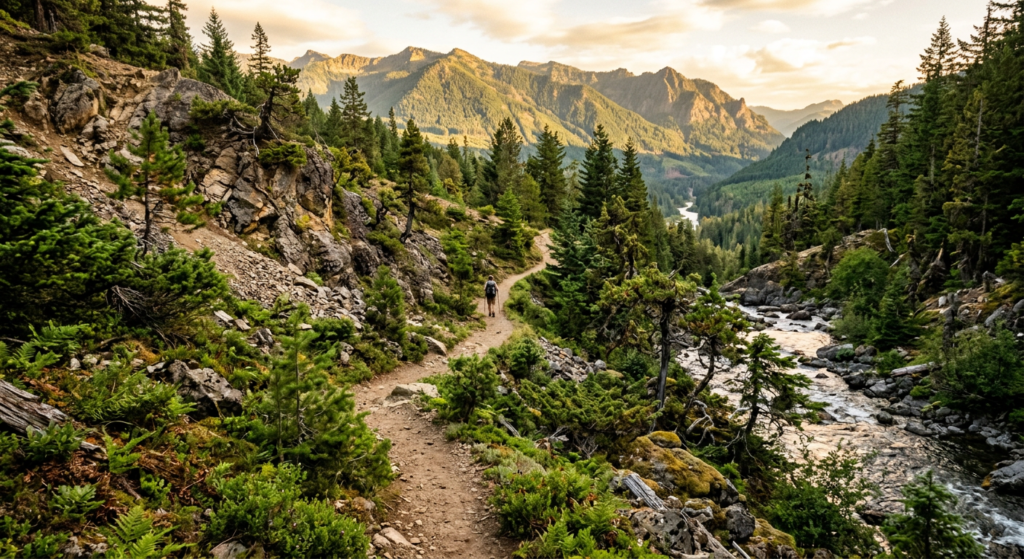
The Sacred Rules: Ethics & Wildlife Protection
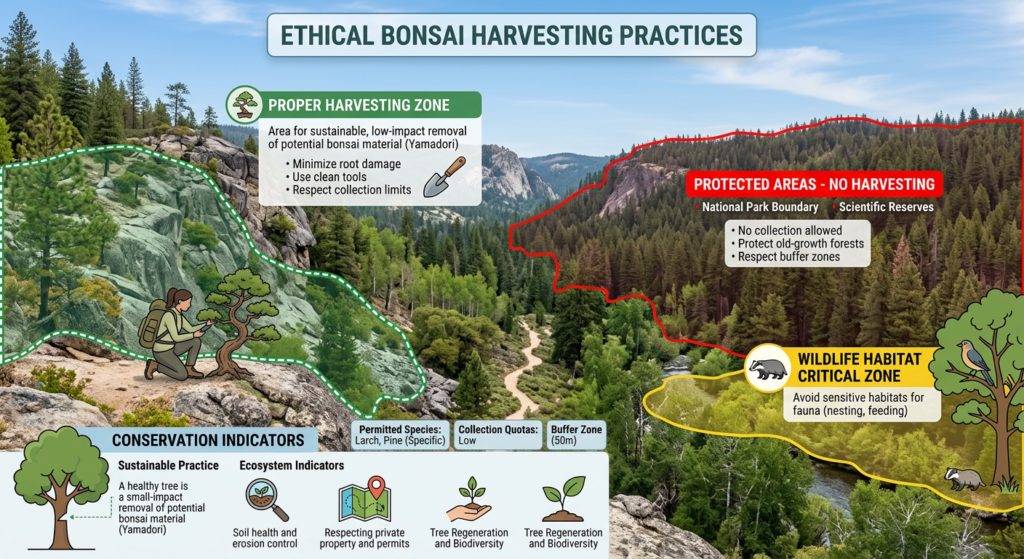
This is non-negotiable. You are entering someone else’s home, the home of plants, animals, and entire ecosystems. Harvesting bonsai is not a right; it’s a privilege that only works if you’re responsible.
Legal Boundaries
- Check permit requirements: Many areas require permits for plant collection. Some prohibit it entirely. Call your local Forest Service ranger station or Parks & Rec office before you go. This takes 15 minutes and prevents legal disaster.
- Respect protected species: Endangered and threatened plants are illegal to collect, period. Learn the protected list for your region.
- Stay on public land: Private property requires permission. Protected areas (state parks, some preserves) often prohibit collection entirely.
- Honor seasonal closures: Some areas close to collection during fire season, habitat protection periods, or research studies.
Ethical Harvesting Practices
- Never take from a population of fewer than 10 visible trees: If you see only 3 specimens of a species in an area, leave them. Take nothing.
- Never harvest 100% of the saplings in a micro-habitat: Leave at least 75% of young trees. You’re thinning, not clear-cutting.
- Avoid rare or slow-growing species: Junipers take decades to recover. If it’s slow-growing, think twice. Fast-growing species (some pines, maples) recover better.
- Take the smallest specimen that meets your criteria: Let the big healthy trees produce seeds and regenerate the population.
Wildlife Considerations
- Watch for nests, burrows, and shelters: If a tree is clearly occupied (active bird nest, insect colony), leave it. Return in off-season.
- Minimize soil disturbance: You’re extracting one small tree, not excavating. Dig gently, disturb as little surrounding soil as possible.
- Never use pesticides or herbicides as part of your extraction: Let the tree be as natural as possible.
- Leave the area better than you found it: Fill holes, don’t scatter soil, pack out all trash, and be mindful of erosion.
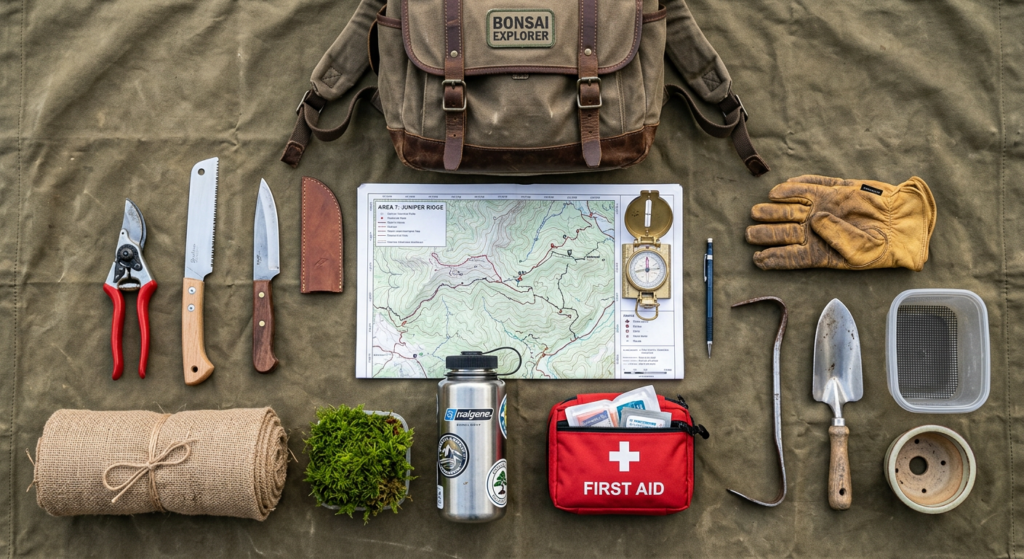
Gear Up: Tools & Supplies for the Expedition
You need the right equipment. This isn’t just about comfort, it’s about doing the job right and doing it safely.
Essential Harvesting Tools
- Sharp bonsai knife or small Japanese saw: A clean cut heals better than a torn root ball. Budget $20–40.
- Pruning shears: For cutting larger roots and branches. Keep them sharp.
- Small folding spade or trowel: Lightweight, packable, durable. Titanium is worth the cost if you’re serious.
- Root cloth or burlap: Wrap the root ball immediately after extraction to prevent drying. Bring 3–4 pieces, different sizes.
- Moss (sphagnum or fine moss): Pack moist into the root cloth to keep roots alive during transport. Bring more than you think you’ll need.
- Work gloves: Heavy-duty gardening gloves protect your hands from thorns, sharp rocks, and blisters.
- Collection container: A small ventilated box or basket for the specimen during your hike out. Avoid sealed plastic, roots need air.
Get a professional bonsai tool kit here – Everything above in one package, ready to go.
Expedition Supplies
- Water: 2–3 liters. You’ll need it for misting the specimen and staying hydrated.
- Headlamp or flashlight: Even a day hike can turn into dusk collection. Bring light.
- First aid kit: Cuts from tools and thorns happen. Include blister treatment, bandages, pain relief, and any personal medications.
- Topographic map and compass: GPS is great, but tech fails. Know where you are.
- Rain jacket or weatherproof layer: Conditions change fast in mountains.
- Snacks and energy food: Low blood sugar = poor decisions. Bring enough to stay sharp.
- Phone and emergency whistle: Safety first.
- Small notebook and pencil: Record the location, species, soil type, exposure (N/S facing), and elevation. This data is gold for care later.
- Ziplock bags: Various sizes for soil samples, seeds, or photos.
- Rope or paracord: 20–30 feet. Useful for securing gear and helping with steep terrain.
Backpack Recommendations
A comfortable 25–35L backpack with good lumbar support is ideal. You’ll be carrying tools, specimens, water, and gear over uneven terrain, often in heat. Invest in something with proper padding, your back will thank you on a 4–5 hour hike.
Shop quality hiking backpacks here – Rated for durability and comfort on rough terrain.
Essential first aid kits for wilderness expeditions – Compact, complete, and ready for the trail.
On the Trail: The Step-by-Step Expedition
You’ve scouted. You’ve prepared. Now you’re out there. Here’s how to do it right.
Step 1: Identify Your Target (15–30 minutes per specimen)
You’re looking for trees that are naturally dwarfed and character-filled. Size matters less than structure. The ideal wild bonsai candidate has:
- A visible trunk with some girth: At least pencil-thick, ideally thicker. This gives you material to work with.
- Natural taper: The trunk should be thicker at the base and taper toward the apex. This is already half your styling work done.
- Existing branch structure: Multiple branches at various heights, preferably with some asymmetry.
- Healthy foliage: Green, not yellow or sparse. A stressed tree is stressed, but a dead-looking tree is just dead.
- Accessible root ball: You need to be able to extract the entire root system without destroying it. Avoid trees locked between massive rocks (unless you have time to carefully excavate).
- Age signs: Rough bark, multi-toned wood color, lichen or moss growth, these suggest age and character.
Don’t get hypnotized by size. A 4-inch juniper with perfect form beats a 12-inch spruce with mediocre branching every time.
Step 2: Assess the Site (5 minutes)
Before you dig, know what you’re working with:
- Soil type: Sandy? Clay? Rocky? This affects your extraction technique and later care.
- Moisture: Is the soil wet or dry? Wet soil holds together better during extraction. Dry soil might crumble.
- Root depth: Gently probe around the tree with your trowel to sense how deep roots go. Aim to extract at least 8–12 inches below the trunk.
- Obstructions: Rocks, roots from nearby plants, dense clay. Plan your digging angle to avoid these.
Step 3: The Extraction (30–45 minutes for a solid specimen)
Timing matters. Early morning is best, cooler, less stress on the tree, and soil is often more workable from overnight moisture.
- Clear the immediate area: Remove leaf litter and debris around the base to see what you’re working with.
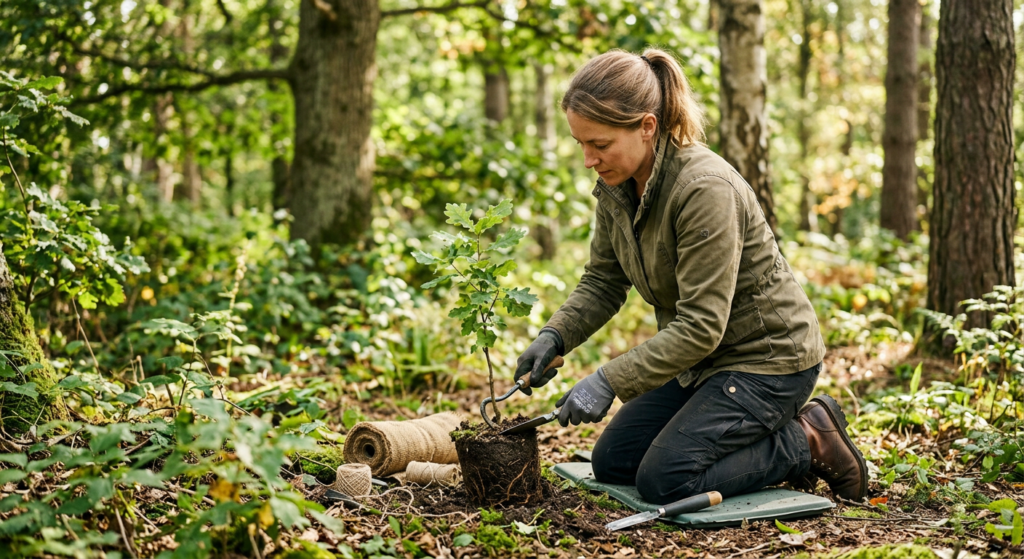
- Start digging wide and deep: Begin your trench 4–6 inches away from the trunk. Work in a circle, not straight down. This loosens the root ball gradually without shocking the tree.
- Be patient with the root ball: As you dig, roots will become visible. Expose them carefully. Don’t yank or cut roots unless absolutely necessary. Work around them.
- Undercut the root ball: Once you’ve gone 8–12 inches deep (deeper is better), work your spade horizontally beneath the roots to sever the deep taproot and create a clean separation.
- The lift: Support the root ball with your hands as you gently rock the specimen free. Go slow. If it’s stuck, dig more rather than force it. Broken roots mean slower recovery.
- Immediate wrapping: The moment the root ball clears the soil, it’s at risk. Immediately wrap the root ball in moist moss, then burlap. The goal is to keep roots cool and hydrated during transport.
- Prune aggressively if needed for transport: If the specimen is too large to carry safely, it’s okay to cut back the canopy 30–50% to reduce weight and stress. The roots are what matter right now. Branches will regrow.
Step 4: Transport & Care During the Hike
- Keep the specimen upright and shaded during the hike out.
- If the hike is more than 2 hours, mist the foliage lightly every 30 minutes if possible.
- Don’t let the root ball dry out. Check it periodically. If moss feels dry, mist it.
- Avoid excessive jostling. Place it carefully in your pack or carry it in your hands if the terrain is rough.
- Get it home and into recovery as quickly as possible.
Step 5: Document Everything
Before you leave the site, spend 5 minutes recording:
- GPS coordinates or clear directions to the exact location
- Species and any unique identifiers (unusual coloring, lichen, nearby landmarks)
- Elevation, aspect (which direction does it face?), and microhabitat description
- Soil type (collect a small sample in a ziplock bag)
- Date and weather conditions
- Photos of the site, the tree before extraction, and the extracted specimen
This data is invaluable. Years from now, when your tree is a masterpiece, you’ll want to know exactly where it came from. You might return to that spot for future collections or to monitor the area’s recovery.
Post-Hunt Care: The Critical 6–12 Weeks
You made it home. Your prize is sitting in your workspace, root ball wrapped, looking bruised and stressed. This is the most important phase of your entire journey. Most failures happen here.
Week 1–2: Recovery Mode
Goal: Minimize shock and prevent root rot.
- Place the specimen in bright, indirect light (not harsh direct sun).
- Keep humidity high (70–80% if possible). A humidity tray or misting station helps. Avoid dry indoor heat.
- Do NOT repot yet. The burlap stays on. The root ball is fragile.
- Mist the foliage 2–3 times daily. Roots aren’t ready to drink much yet; foliage absorbs moisture instead.
- Water the root ball sparingly. Soil should be moist but never waterlogged. Soggy = root rot = game over.
- No fertilizer. No styling. No stress. Just recovery.
Week 3–6: Stabilization
Goal: Watch for new growth and root activity.
By now, you should see signs of recovery:
- New leaf buds forming
- Foliage color improving (less pale, less droopy)
- Slight growth at branch tips
If you see none of these by week 4, your tree is struggling. Increase humidity, check for root rot (smell, rot smells bad), and consider whether your specimen was viable when you collected it.
During this phase:
- Continue misting and humidity.
- Keep watering conservative. Feel the soil. Water only when the top inch feels dry.
- You can now carefully remove the burlap if new growth is visible. Inspect roots, they should be white/cream-colored, not black or mushy.
- If repotting (only if roots are clearly rotting), use fast-draining bonsai soil, not potting soil.
Week 7–12: Growth Phase
Goal: Establish the specimen as a living, growing bonsai.
- By week 8, most healthy specimens show vigorous new growth.
- Gradually increase light (move toward brighter conditions).
- Begin light watering once you see consistent growth.
- You can now apply diluted fertilizer (1/4 strength) to support new growth.
- Reduce misting frequency as the plant establishes (aim for morning misting only).
- Still no structural styling. Let the tree focus on roots and growth.
Premium bonsai soil & care supplies – Everything you need for successful recovery and long-term health.
From Specimen to Masterpiece: The Long Game
Congratulations. Your wild specimen survived. It’s established, growing, and ready for the real work: becoming a bonsai masterpiece takes years.
This is where patience separates casual collectors from bonsai masters. You’re not done. You’re just getting started.
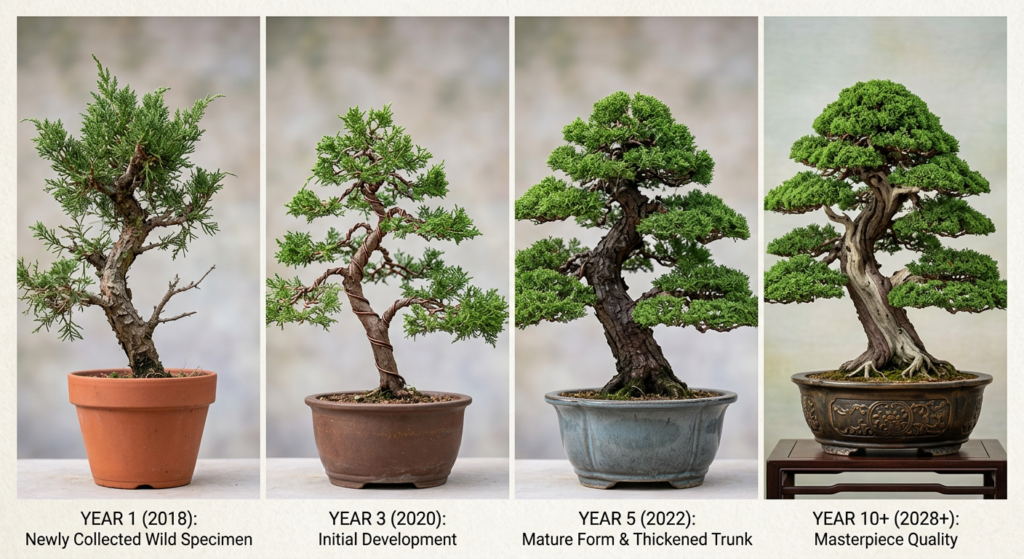
Year 1: Observation & Light Development
- Let the tree grow freely for the first full growing season. Vigorous growth rebuilds strength.
- In late fall, prune back lightly to develop branching structure.
- Watch how the tree responds to your climate. Note growth patterns, seasonal changes, water needs.
- Begin studying bonsai styling principles: apex shape, branch angles, negative space, taper.
- Consider what style suits this particular specimen’s character, formal upright, informal, slanting, cascade?
Years 2–3: Active Shaping
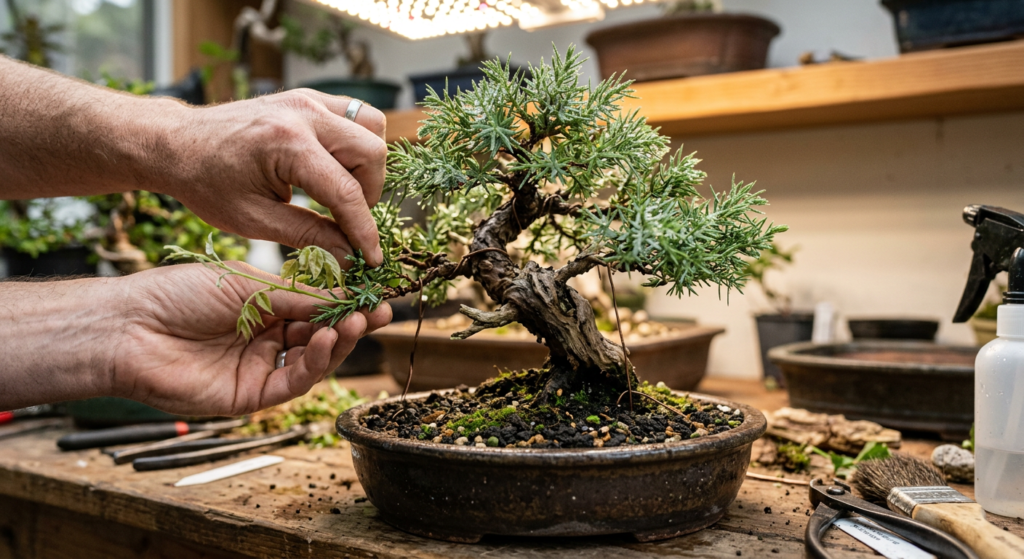
- Now you can begin wiring and styling.
- Make one major structural change per season, not all at once. Trees need time to adjust.
- Defoliation, repotting, and root pruning can happen 1–2 times per year as the tree strengthens.
- Study under a mentor or take a bonsai class. Technique matters enormously.
Year 5+: Refinement & Maturity
By year 5, your wild specimen has become something extraordinary. The trunk is thicker. The ramification (fine branching) is intricate. The character is undeniable. This is a true bonsai, not a tree forced into a shape, but a tree that has been patiently developed into art.
This is also when you begin thinking about your next collection. And your next. The mastery never ends.
Training pots and ceramic vessels for styling – The right container makes all the difference as your masterpiece develops.
Your Bonsai Journey Begins Now
Finding a wild bonsai is not the end goal. It’s the beginning of a lifelong adventure. The tree you find on a sunny Saturday might spend the next 50 years in your care, transforming from a scrappy wilderness survivor into a living masterpiece.
This is why we do this. Not for the quick win or the Instagram photo, but for the decade-long relationship you’ll build with a tree you found yourself.
Ready to start your expedition? Here’s what I want you to do:
- Identify one promising hunting ground within 2 hours of home. Scout it this month. Don’t collect yet, just look.
- Research the legal requirements for your region. Call your local Forest Service office. Know the rules before you hunt.
- Start your expedition kit. You don’t need everything at once, but gather the basics over the next few weeks.
- Join or follow a bonsai community (online or in-person). You’ll need mentorship on the care side. Connect with people doing this work seriously.
And when you find your first tree, that moment of discovery, that sudden recognition of character and potential, come back and tell us about it. Share your photos, your journey, your challenges. This is how the bonsai community grows. Your adventure inspires others to begin their own.
The wilderness is waiting. Your masterpiece is out there. Go find it.
What will your first collection be? Share your hunting plans in the comments, location, target species, timeline. Let’s build this adventure together. 🌱
About Coastal Roots Botanica
We’re a husband-and-wife team based in Santa Cruz, California, obsessed with everything growing, from delicate bonsai to wild plants and handcrafted terrariums. We believe the best way to become a bonsai master isn’t through nursery stock alone, but through understanding plants in their wild habitat. If you’re serious about the journey, we’re here to help with tools, supplies, and genuine guidance every step of the way.
Ready to stock up before your expedition? Check out our bonsai tool kits and hardy species collection designed specifically for collectors and hunters.
What’s Next?
You’ve got the knowledge. Now it’s about execution, patience, and showing up consistently. Welcome to the bonsai quest. 🗺️